News and Press Releases
From invisible to recognisable tumour: a new strategy to improve response to immunotherapy
A study published in Cancer Discovery, conducted in the laboratories of IFOM in partnership with researchers from the University of Turin and the University of Milan, with contributions from international partners, has shown for the first time that it is possible to pharmacologically transform "cold" tumours - invisible to the immune system - into tumours that can be recognised and treated with immunotherapy. The approach is based on the selective inhibition of the "mismatch repair" system - the cellular machinery that corrects errors arising when DNA is copied during cell replication - using an experimental molecule. The findings open new perspectives for the treatment of cancers that currently lack effective immunotherapy options, including colorectal, pancreatic and breast cancer.
The study was made possible thanks to the support of Fondazione AIRC for cancer research and the European Research Council (ERC).
Milan/Turin, 21 April 2026 — Immunotherapy has transformed cancer treatment. Rather than targeting the tumour directly, it harnesses the immune system's ability to recognise and attack it - in some patients with melanoma and certain forms of lung cancer, responses have led to complete eradication of advanced disease. Yet many solid tumours - including most colorectal, pancreatic and breast cancers - remain unresponsive to immunotherapy. These so-called "cold" tumours lack the signals needed to trigger an immune response, leaving the majority of patients with these diagnoses without access to this therapeutic option. "In colorectal cancer, only around 5% of metastatic cases carry the molecular features that currently predict a good response to immunotherapy. In pancreatic cancer, that figure drops to roughly 1-3%, while in breast cancer the benefit is largely confined to specific subgroups, such as some forms of triple-negative disease," explains Alberto Bardelli, Scientific Director of IFOM and Full Professor at the University of Turin.
Rendering the invisible visible: this is the challenge at the heart of the study just published in Cancer Discovery by researchers from IFOM, the AIRC Institute of Molecular Oncology, and the Universities of Turin and Milan. The data show how an experimental molecule can switch on "molecular beacons" on the tumour, turning it into a target for the immune system and potentially extending the reach of immunotherapy to cancers currently beyond its scope. The team focused on a specific DNA quality-control mechanism known as mismatch repair - the system responsible for correcting copying errors that accumulate during cell replication. In a counterintuitive move, rather than trying to preserve its function, the researchers found a way to temporarily shut it down. "Our results show that it is possible to use a molecule to convert a tumour that is initially invisible to the immune system into one that can be recognised and treated with immunotherapy. This is a paradigm shift: we are not just targeting tumour growth, we are rewriting how the tumour communicates with the body," comments Alberto Bardelli.
It was already known that tumours with a natural mismatch repair defect accumulate large numbers of mutations and become more visible to the immune system. What remained unknown was whether this state could be replicated pharmacologically - whether the same vulnerability could be artificially induced. The answer, the data suggest, is yes. The key is NP1867, a small experimental molecule that selectively inhibits PMS2, one of the core proteins in the mismatch repair pathway. Working with tumour cell cultures and laboratory animal models, the team performed longitudinal genomic analyses to track how cells evolved under prolonged treatment with the DNA repair inhibitor. The results were striking: treated tumour cells acquired the hallmark features of tumours naturally sensitive to immunotherapy - high mutational burden, new tumour antigens, and increased immunogenicity. The mutations introduced by the treatment act as "molecular beacons", generating abnormal proteins that the immune system can detect, effectively making a previously hidden tumour visible. "In 2017 we published in Nature the demonstration that tumours with natural mismatch repair defects respond extraordinarily well to immunotherapy. That discovery raised a precise question: can we artificially induce this state in tumours that currently lack it? This study answers yes. It is an important conceptual step, with very concrete implications for cancers that remain resistant today," explains Giovanni Germano, Associate Professor at the Department of Medical Biotechnology and Translational Medicine, University of Milan, and co-author of the paper.
The study brought together expertise in medicinal chemistry, structural biology, genomics and tumour immunology through a collaboration between IFOM, the University of Turin, British company NeoPhore, the University of Milan and other international partners. Special thanks go to Fondazione AIRC for cancer research and the European Research Council, without whose support the work would not have been possible. "The turning point was observing that, after prolonged exposure to the compound, tumour cells progressively accumulated the same mutational signatures and microsatellite instability seen in tumours with natural mismatch repair deficiency. When those tumours then became sensitive to immunotherapy, it became clear that the approach was not simply altering DNA - it was genuinely reprogramming the relationship between the tumour and the immune system," recounts Dr Eleonora Piumatti, IFOM researcher and first author of the paper. The true eureka moment came when tumours derived from NP1867-pretreated cells showed delayed growth and, in some cases, complete regression following anti-PD-1 immunotherapy - while untreated control tumours remained fully resistant. Molecular analyses confirmed an increase in tumour-infiltrating lymphocytes and greater activation of antigen-presentation genes, the signals that flag the tumour to the immune system.
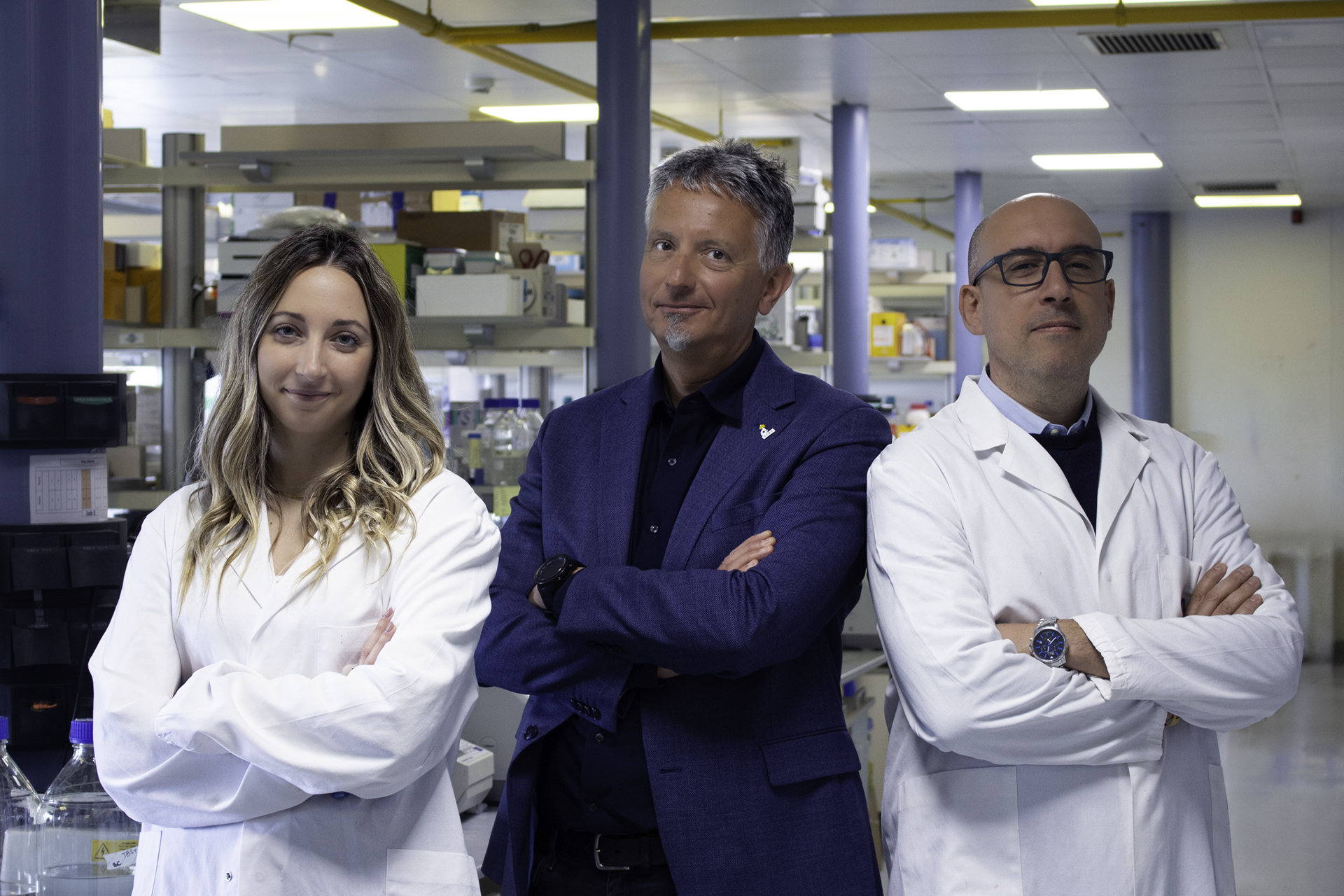
Eleonora Piumatti, Alberto Bardelli, Giovanni Germano
The implications of these findings are wide-ranging. If the approach can be developed further, it may one day make immunotherapy accessible to patients with colorectal and pancreatic cancers, as well as other immunologically cold tumour types for which no immune-based options currently exist. The immediate next steps are to develop molecules with pharmacological profiles suited to prolonged in vivo use, and to move towards more clinically relevant preclinical models to define the optimal timing, dosing and therapeutic combinations. "This whole project grew from a scientific bet - that we could artificially induce the immunological vulnerability that, in tumours with natural mismatch repair deficiency, drives exceptional responses to immunotherapy. We now have evidence that the bet was well placed. The road to patients will require further validation, but the proof of concept is there," says Germano. "The goal is to unlock immunotherapy for the big killers of modern oncology - colorectal, pancreatic and breast cancers - which remain largely invisible to the immune system. We want to develop drugs that can create, in a controlled way, an immunological vulnerability where none exists today. The next step is to advance a molecule into clinical investigation, and ultimately to expand the pool of patients who can benefit from immunotherapy," concludes Bardelli.
Julian Blagg, Philippe Riou, Alexia Hervieu, Eleonora Piumatti, Maria T Rodriguez-Plata, Paolo Battuello, Adam Peall, Vito Amodio, Pietro Paolo Vitiello, Daniel J H Nightingale, Ruzica Bago, Paige Tongue, Tessa Slater, Kalpesh Parmar, Pradip Patel, Javier Rodríguez González, David E Clark, Gareth W Langley, Charles Nichols, Alba Guarne, Paul C M Winship, Matthew Baker, Martin Drysdale, Giovanni Germano, Alberto Bardelli
Pharmacological inhibition of PMS2 induces MMR deficiency and response to immune checkpoint blockade
Cancer Discov. 2026 Apr 21. doi: 10.1158/2159-8290.CD-26-0003. Online ahead of print.